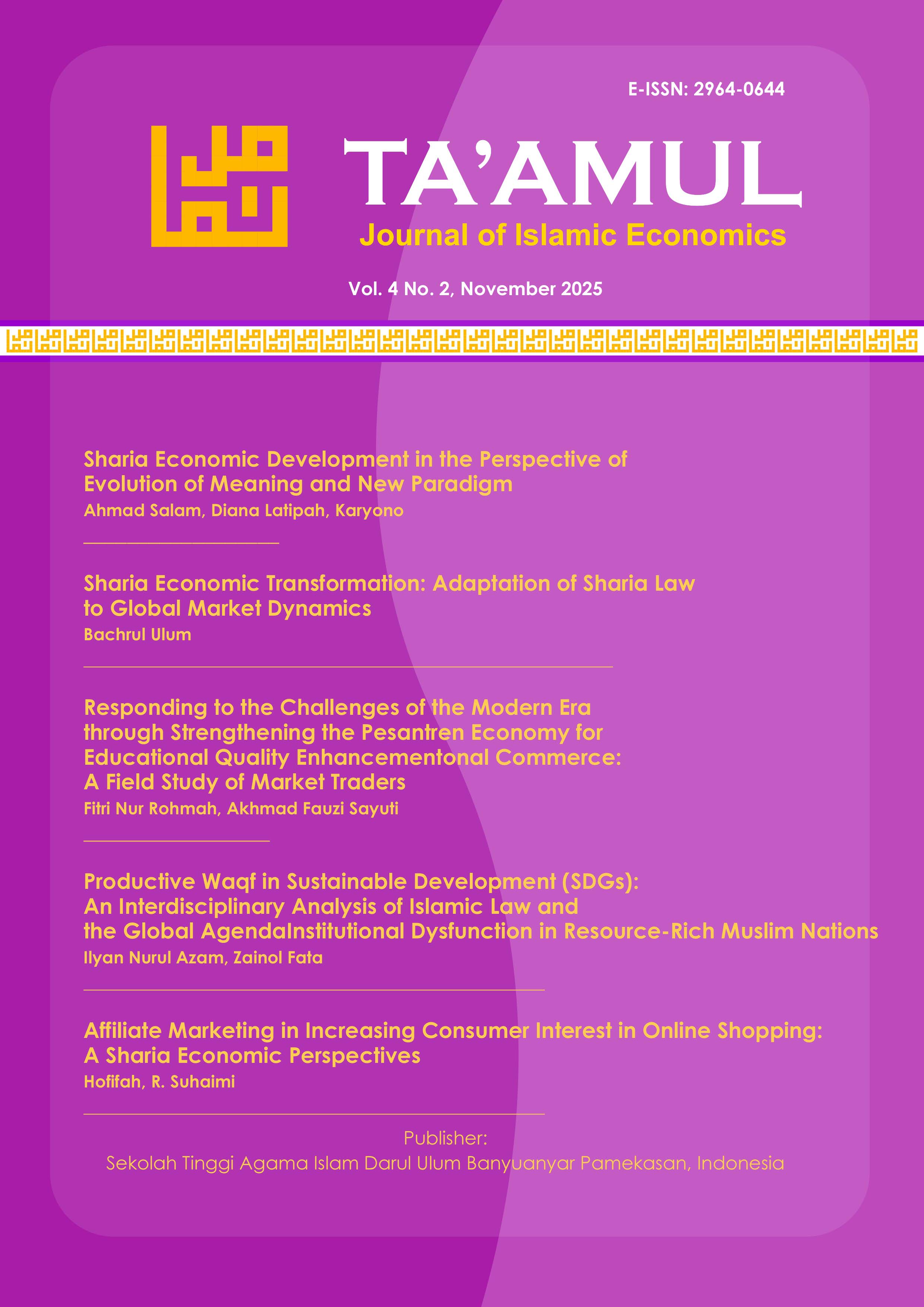
Responding to the Challenges of the Modern Era through Strengthening the Pesantren Economy for Educational Quality Enhancement
DOI:
https://doi.org/10.58223/taamul.v4i2.468Keywords:
Pesantren, Business, Educational QualityAbstract
The main problem underlying this research is the number of pesantren that are not economically independent so that it depends on the help of the government, large contributions from santri, and charity. The formula of the problem in this study is to uncover how Homastas (as one of the economic ventures of Mambaul Ulum Bata-Bata) in sustaining the economic independence of pesantren and how its development strategy. The approach in this study was conducted with the qualitative method of single case studies in supermarket Homastas cottage pesantren Mambaul Ulum Bata-Bata Pamekasan Madura. Data is collected by observation methods, in-depth interviews, and archival document studies. Respondents in this study include the board of momisaris, director, unit manager, employee, alumni, and santri. Data is analyzed and checked its validity by triangulation method. The results of the study showed that Homastas played a very important role in the development of Pesantren's economy. Since its establishment in 2018, it has 16 branches and has been proven to support financial pesantren in the field of smooth education, development, and other facilities. The main strategy is to realize supermarkets managed with good and measurable management implementation, provide comfort to customers, and open branches in many places by maximizing the spread of alumni in 4 districts in Madura. Business continuity should be followed by cultivating integrity attitudes and maintaining the values of pesantren in its business practices. These findings contribute to the development of the theory of pesantren economics that one of the key to the economic independence of pesantren is the leadership of kiai and religious values integrated with modern management patterns.
References
Ahmady, N. (2013). Pesantren dan Kewirausahaan: Peran Pesantren Sidogiri Pasuruan Dalam Mencetak Wirausaha Muda Mandiri. Penelitian Individu.
Arif, Z. (2019). Optimalisasi Peluang Dan Tantangan Ekonomi Islam Dalam Menghadapi Masyarakat Ekonomi Asean. Al Maal: Journal of Islamic Economicsand Banking. Vol 3 (Issue: 2, pp. 68-83).
Arifin, Z. (2012). Perkembangan Pesantren di Indonesia. In Pendidikan Agama Islam: Vol. IX (Issue 1, pp. 40–53).
Ariyanti, N., & Himsyah, U. Z. A. (2021). Pembentukan Karakter Kepemimpinan Profetik Berbasis Trilogi Kepemimpin an Ki Hajar Dewantara melalui Kegiatan Kepramukaan. In Tarbiyatuna: Jurnal Pendidikan Ilmiah (Vol. 6, Issue 1, pp. 27–40). Sekolah Tinggi Ilmu Tarbiyah Ibnu Sina Malang.
Damanhuri, A., Mujahidin, E., & Hafidhuddin, D. (2013). Inovasi Pengelolaan Pesantren dalam Menghadapi Persaingan di Era Globalisasi. 2(1), 2252–5793.
Fadli, M. Z., & Syafi’i, I. (2021). Tantangan Dunia Pesantren Era Milenial. AL-MURABBI: Jurnal Studi Kependidikan Dan Keislaman, 7(2), 134–141.
Istiqamah, A. N., Kurnianto, R., & Saputro, A. D. (2018). Manajemen Pesantren Mahasiswa Dalam Membentuk Karakter Religius Di Pesantren Mahasiswa Al-Manar Universitas Muhammadiyah Ponorogo. TARBAWI:Journal on Islamic Education, 2(2), 12-28.
Karim, A. (2016). Managerial Inspiration in the Traditional Pesantren. UMRAN- International Journal of Islamic and Civilizational Studies (EISSN: 2289-8204), 3(3–1), 73–84.
Muallif, M. (2017). Kepemimpinan Kyai dalam Peningkatan Kualitas Pendidikan Pesantren. TESIS: UIN MALIKI.
Muhakamurrohman, A. (1970). Pesantren: Santri, Kiai, Dan Tradisi. IBDA` : Jurnal Kajian Islam Dan Budaya, 12(2), 109–118.
Muhammad, J. (2012). Metamorfosis Pesantren Di Era Globalisasi. In Cendikia (Vol. 20, Issue 1, p. 28).
Mulyadi, M. (2017). Charismatic Leadership. IJER-Indonesian Journal Of Educational. (Vol.15, Issue 3, p. 286-302.
Nadir, M. (2017). Gerakan Ekonomi Pesantren (Studi atas Pesantren Sidogiri Pasuruan). IQTISAD, 4(2).
NS, S. (2017). Model Pengembangan Ekonomi Pondok Pesantren. In EDUKASI: Jurnal Penelitian Pendidikan Agama dan Keagamaan (Vol. 6, Issue 3).
Rachman, A. A. (2014). the Impact of Authoritarian Leadership System. Religió: Jurnal Studi Agama-Agama, 4(1), 1–28.
Rasyid, H. (2012). Peran Pesantren dalam Mengembangkan Ekonomi Islam. Academia. (Vol 2, Issue: 2, 45-53).
Sholikhah, V. (2022). Implementasi Strategi Pengembangan Koperasi Pesantren Sebagai Pusat Ekonomi Mandiri di Pesantren Al-Qodiri Jember. Jurnal Ekonomi Dan Bisnis Islam (JEBI), 2(2), 104–113.
Syaehotin, S., & Anam, N. (2017). Improvisasi Pesantren Sebagai Subkultur Di Indonesia. In Al Qodiri : Jurnal Pendidikan, Sosial dan Keagamaan (pp. 34–60).
Downloads
Published
How to Cite
Issue
Section
License
Copyright (c) 2025 Fitri Nur Rohmah, Akhmad Fauzi Sayuti

This work is licensed under a Creative Commons Attribution 4.0 International License.