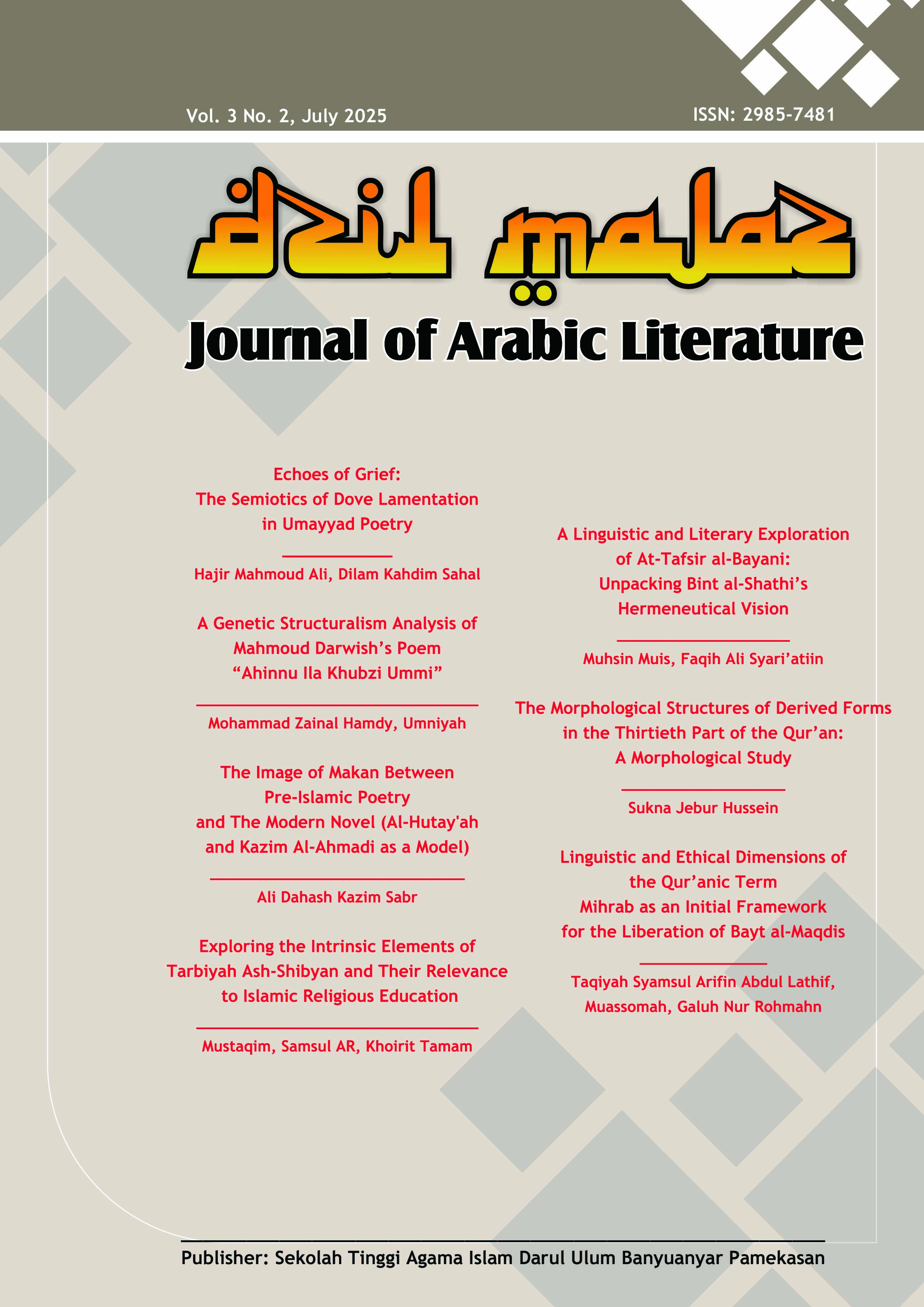
Linguistic and Ethical Dimensions of the Qur’anic Term Mihrab as an Initial Framework for the Liberation of Bayt al-Maqdis
DOI:
https://doi.org/10.58223/dzilmajaz.v3i2.533Keywords:
Mihrab, Baital Maqdis, LiberationAbstract
This study examines the linguistic and ethical meanings of the Qur’anic term miḥrāb and its connection to the broader concept of liberation, particularly the liberation of Bayt al-Maqdis. The problem addressed in this research is the limited scholarly attention to miḥrāb beyond its conventional definition as a physical prayer niche, despite its deeper symbolic significance in the Qur’anic discourse. The study aims to clarify how miḥrāb functions as a spiritual, moral, and prophetic category that shapes individual and communal transformation. Using a textual and semantic analysis of four primary verses—Q 3:37, Q 3:39, Q 19:11, and Q 38:21—this research employs Ṭāhā ʿAbd al-Raḥmān’s theory of al-qirāʾah al-iʾtimāniyyah to explore the ethical trust embedded in the concept. The findings indicate that miḥrāb symbolizes a sacred space of spiritual discipline, moral refinement, and prophetic justice, serving as a formative arena for nurturing rabbānī leadership and spiritually liberated communities. Consequently, the liberation of Bayt al-Maqdis must begin with revitalizing spirituality through the symbolic and ethical dimensions of miḥrāb, rather than relying solely on militaristic approaches. The study contributes a conceptual framework that positions miḥrāb as a foundational paradigm for the civilizational liberation project within Islamic thought
References
‘Abd al-Ḥamīd, T. (2021). Al-Qiyam al-taknūlūjiyyah wa al-tashkīliyyah li al-miḥrāb. Majallat al-‘Imārah wa al-Funūn wa al-‘Ulūm al-Insāniyyah, 6(2), 819–841. https://doi.org/10.21608/mjaf.2020.46233.1925
‘Abd al-Raḥmān, Ṭ. (2000). Su’āl al-akhlāq. Al-Markaz al-Thaqāfī al-‘Arabī.
‘Abd al-Raḥmān, Ṭ. (2006a). Al-Ḥaqq al-‘arabī fī al-ikhtilāf al-falsafī. Al-Markaz al-Thaqāfī al-‘Arabī.
‘Abd al-Raḥmān, Ṭ. (2006b). Rūḥ al-ḥadāthah. Al-Markaz al-Thaqāfī al-‘Arabī.
‘Abd al-Raḥmān, Ṭ. (2012). Su’āl al-‘amal. Al-Markaz al-Thaqāfī al-‘Arabī.
‘Abd al-Raḥmān, Ṭ. (2018). Thuġū al-rābiṭah. Markaz Maghārib.
‘Adnān, M. (2019). Al-Mukawwināt al-māddiyyah li-mu’assasat al-masjid wa atharuhā: al-miḥrāb wa al-minārah. Al-Majallah al-Qānūniyyah wa al-Ijtimā‘iyyah, 4(4), 224–237.
‘Āshūr, M. al-Ṭ. (1984). Al-Taḥrīr wa al-tanwīr. Al-Dār al-Tūnisiyyah li al-Nashr.
‘Aṭā’, M. ‘A. (2018). Mas’alat al-miḥrāb li Ibn Khālawayh: Taḥqīqan wa dirāsah. Majallat Jīl al-Dirāsāt al-Adabiyyah wa al-Fikriyyah, 5(38), 117–130.
‘Umar Sirāj Abū Razīzah. (2019). Al-ḥājah ilā murāja‘at taḥwīl al-imām ilā al-miḥrāb al-nabawī. Majallat Qiṭā‘ Uṣūl al-Dīn, 13. https://journals.ekb.eg/article_96167
Al-Aṣfahānī, A. al-Q. b. M. al-Ḍ. (1412). Al-Mufradāt fī gharib al-Qur’ān (Ṣ. ‘A. al-Dāwūdī, Ed.). Dār al-Qalam / al-Dār al-Shāmiyyah. https://shamela.ws/book/23636
Al-Baghā, A. (2019). Faḍā’il Bayt al-Maqdis bayna al-muḥaddithīn wa al-mu’arrikhīn min khilāl kitābay Miftāḥ al-maqāṣid wa Faḍā’il Bayt al-Maqdis. Al-Majallah al-Dawliyyah li-Abḥāth al-Ḥadīth, 3, 99–128. https://doi.org/10.5281/zenodo.3595389
Al-Baghawī, M. b. A. b. M. b. M. (1997). Ma‘ālim al-tanzīl fī tafsīr al-Qur’ān (Tafsīr al-Baghawī) (M. ‘A. A. al-‘Ajlānī, Ed.). Dār Ṭayyibah.
Al-Fārūqī, I. R. (2000). Al-Tawḥīd: Its implications for thought and life. International Institute of Islamic Thought. https://doi.org/10.2307/j.ctvk8w28n
Al-Qādir, Sh. M. ‘A. (2022). Bayt al-Maqdis arḍ al-nubuwwāt wa manba‘ al-barakāt min khilāl al-sunnah al-nabawiyyah al-muṭahharah. Al-Mu’tamar al-‘Ilmī al-Duwalī al-Awwal, 1(1), 666–738. https://doi.org/10.21608/icfgs.2022.229395
Al-Qurṭubī, A. ‘A. M. b. A. (1964). Al-Jāmi‘ li-aḥkām al-Qur’ān. Dār al-Kutub al-Miṣriyyah.
Al-Rāzī, F. (1420). Mafātīḥ al-ghayb (al-Tafsīr al-kabīr). Dār Iḥyā’ al-Turāth al-‘Arabī.
Al-Sa‘dī, ‘A. b. N. b. ‘A. (2000). Taysīr al-karīm al-raḥmān fī tafsīr kalām al-mannān (‘A. b. M. al-Luwayḥiq, Ed.). Mu’assasat al-Risālah. https://shamela.ws/book/42
Al-Shāṭibī, I. b. M. b. M. al-M. A. (1997). Al-Muwāfaqāt. Dār Ibn ‘Affān. https://www.noor-book.com/كتاب-الموافقات-ت-مشهور-pdf
Al-Ṭabarī, A. J. M. b. J. (1994). Jāmi‘ al-bayān ‘an ta’wīl āy al-Qur’ān. Mu’assasat al-Risālah. https://www.noor-book.com/
Al-Ṭabarī, Muḥammad b. Jarīr. (n.d.). Jāmi‘ al-bayān ‘an ta’wīl āy al-Qur’ān (p. 100). Mu’assasat al-Risālah.
Al-Zamakhsharī, M. b. ‘U. b. A. (1987). Al-Kashshāf ‘an ḥaqā’iq ghawāmiḍ al-tanzīl (M. Ḥ. Aḥmad, Ed.). Dār al-Rayyān li al-Turāth.
Al-Zuḥaylī, W. (1991). Al-Tafsīr al-munīr fī al-‘aqīdah wa al-sharī‘ah wa al-manhaj. Dār al-Fikr.
Būsalām, A. (2020). Shakhsiyyāt ghā’ibah ḥāḍirah fī taḥrīr Bayt al-Maqdis. Majallat Dirāsāt Bayt al-Maqdis, 3(20), 411–432. https://doi.org/10.31456/beytulmakdis.810271
Creswell, J. W. (2014). Research design: Qualitative, quantitative, and mixed methods approaches. SAGE Publications.
Fauziah, M. (2025). Prophetic ethics and the foundations of Islamic leadership. https://doi.org/10.22373/el-sunan.v3i1.7679
Gadamer, H.-G. (2004). Truth and method. Continuum Publishing.
Ibn Kathīr, I. b. ‘U. b. Kathīr. (1993). Al-Bidāyah wa al-nihāyah. Dār Iḥyā’ al-Turāth al-‘Arabī.
Kathīr, ‘A. A. A. I. b. ‘U. b. Kathīr. (1998). Tafsīr al-Qur’ān al-‘aẓīm (M. Ḥ. Sh. al-Dīn, Ed.). Dār al-Kutub al-‘Ilmiyyah.
Nugraheni, T., Firmansyah, A., Dian, D., Syuhada, M., & UIN Sunan Kalijaga. (2023). Pendidikan spiritualitas-religius perspektif al-Qur’an: Studi tematik kisah Zakariyā. Al-Manar, 12(1), 124–143. https://doi.org/10.36668/jal.v12i1.495
Nurhayati, M. (2024). Prophetic leadership: The evolution of thought. International Journal of Law Policy and Governance, 3(2), 112–124. https://doi.org/10.54099/ijlpg.v3i2.1069
Sahidin, A. (2021). Kedudukan penting Bayt al-Maqdis bagi umat Islam: Studi historis. Jurnal Penelitian Medan Agama, 12(1), 25. https://doi.org/10.58836/jpma.v12i1.9887
Sahidin, A. (2022). Pembebasan Bayt al-Maqdis oleh Ṣalāḥ al-Dīn al-Ayyūbī 570–583 H: Analisis historis. Agastya, 12(2), 117. https://doi.org/10.25273/ajsp.v12i2.9599
Sahidin, A. (2023). Strategi Ṣalāḥ al-Dīn al-Ayyūbī dalam penaklukan Bayt al-Maqdis. UNIDA Gontor Press.
Shubayr, M. ‘A. (2022). Bayt al-Maqdis wa mā ḥawlah. Hay’at ‘Ulamā’ Filasṭīn.
Susanti, E. (2025). Bayt al-Maqdis dalam sejarah peradaban Islam hingga akhir zaman. Jurnal Kajian Islam dan Sosial Keagamaan, 2(3), 592–598.
Ṭanṭāwī, M. S. (1992). Al-Tafsīr al-wasīṭ li al-Qur’ān al-karīm. Dār al-Ma‘ārif.
Tuwāmah, N. (2016). Jadaliyyat al-uṣūl al-mi‘māriyyah li-‘unṣur al-miḥrāb fī al-‘imārah al-islāmiyyah. Majallat al-‘Ulūm al-Ijtimā‘iyyah wa al-Insāniyyah, 6(11), 123–149. https://asjp.cerist.dz/en/article/37753
Umaymah al-Kharshā’. (2009). Bayt al-Maqdis fī al-‘ahd al-islāmī. Mu’tamar Yawm al-Quds al-‘Āshir, 59–77. https://repository.najah.edu
Zahīroh, N. (2021). Dakhīl al-naqlī fī al-Durr al-manthūr fī al-tafsīr bi al-ma’thūr: Qiṣṣat Dāwūd. UIN Gunung Djati. https://digilib.uinsgd.ac.id/44555/
Zayd, N. Ḥ. A. (2014). Mafhūm al-naṣṣ: Dirāsah fī ‘ulūm al-Qur’ān (1st ed.). Al-Markaz al-Thaqāfī al-‘Arabī. https://archive.org/details/MafhomAlnass
Zuhur, S. (2002). Review of Speaking in God’s Name. The Arab Studies Journal, 10/11(2/1), 203–205. http://www.jstor.org/stable/27933859
Downloads
Published
How to Cite
Issue
Section
License
Copyright (c) 2025 Taqiyah Syamsul Arifin Abdul Lathif, Muassomah, Galuh Nur Rohmah

This work is licensed under a Creative Commons Attribution 4.0 International License.