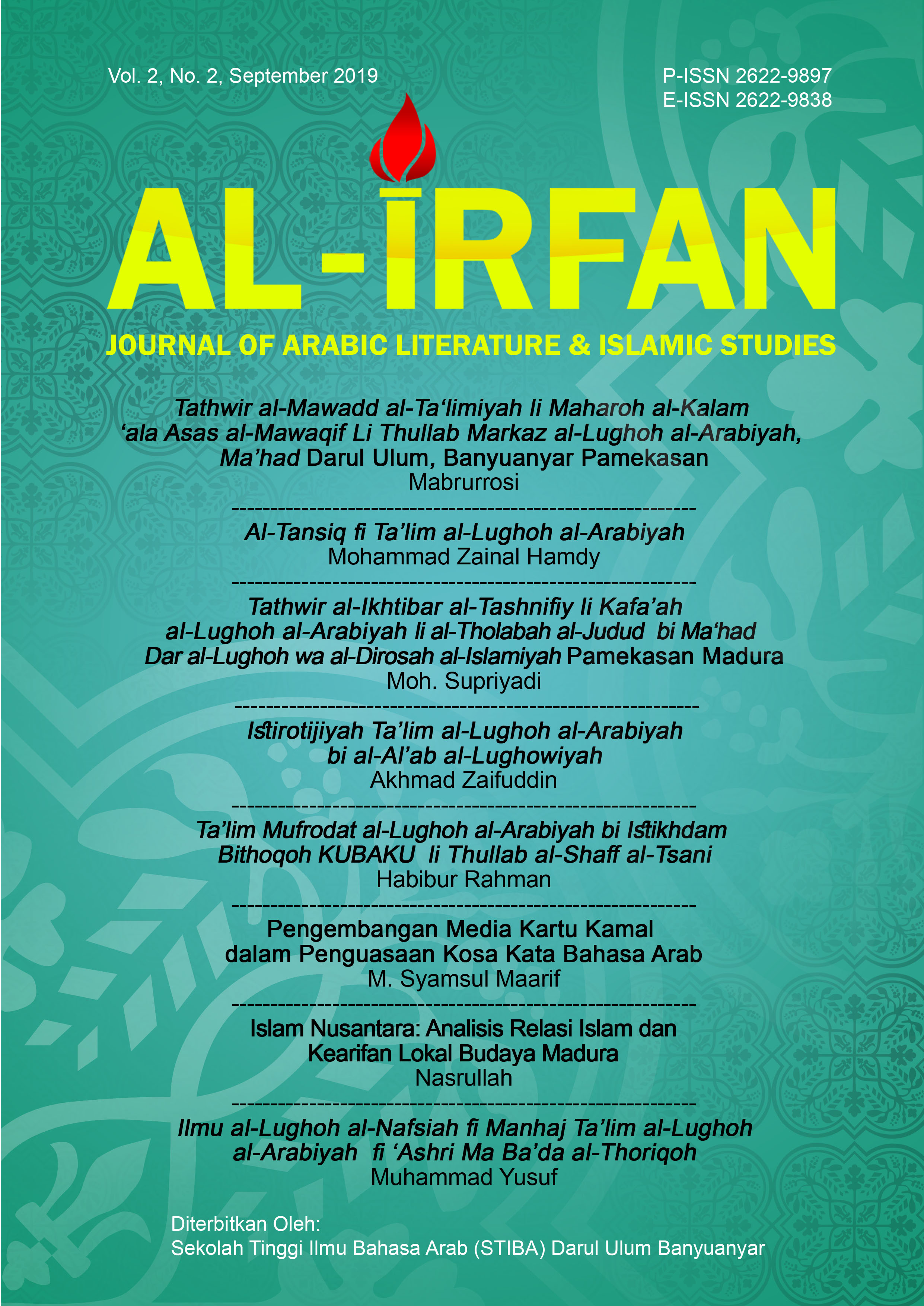
Tathwir al-Mawad al-Taklimiyah lo Maharah al-Kalam 'Ala Asas al=Mawaqif
DOI:
https://doi.org/10.58223/al-irfan.v2i2.674Keywords:
instructional material development, situational-based approach, speaking skillAbstract
The development of instructional materials is an important endeavor and plays a significant role in ensuring the success of the teaching and learning process. The instructional materials found by the researcher in the prescribed textbook for teaching speaking skills to students of the Arabic Language Center at Darul Ulum Banyuanyar Islamic Institute, Pamekasan, are limited and do not accommodate students’ needs for oral practice according to their communicative situations, which would otherwise contribute to the development of their speaking ability. The textbook is confined to dialogues only and merely presents vocabulary scattered across each page. This condition may lead to students’ failure in learning speaking skills. This study aims to develop, produce, and evaluate instructional materials for speaking skills for students of the Arabic Language Center at Darul Ulum Banyuanyar Islamic Institute, Pamekasan, East Java, in order to improve their speaking and communication skills in accordance with their daily situations. The research approach employed is both quantitative and qualitative, using the Research and Development (R & D) methodology. The results of the study can be summarized as follows: (1) The procedures for developing instructional materials for speaking skills for students of the Arabic Language Center at Darul Ulum Banyuanyar, Pamekasan, include needs analysis, planning and design, material development, expert validation, revision and correction, field testing, and final revisions and corrections. (2) The newly developed instructional materials proved effective in improving students’ ability in oral expression in terms of Arabic pronunciation, fluency, and their ability to use vocabulary. This is evident from the comparison between the pre-test and post-test results, where the calculated t value (93.3) is greater than the t table value at the 99% significance level (2.83).
References
Ahmad, Pengembangan Kurikulum. Bandung : Pustaka Setia, 1998.
Arikunto, Suharsimi. Prosedur Penelitian Suatu Pendekatan Praktek (Edisi Revisi). Jakarta: PT Rineka Cipta, 2010.
Efendi, Ahmad Fuad. Metodologi Pengajaran Bahasa Arab. Malang: Misykat, 2004.
Hasan, Iqbal. Analisis Data Penelitian dengan Statistik. Cet.1. Jakarta: PT. Bumi Aksara, 2004.
Majid, Abdul. Belajar dan Pembelajaran. Bandung: PT. Remaja Rosdakarya, 2014.
Makmur. Panduan Pengembangan Bahan Ajar. Jakarta: Depdiknas, 2009.
Miarso, Yusuf Hadi. Menyamai Benih Pendidikan. Jakarta: Kencana, 2009.
Moh. Ainin, dkk, Evaluasi Dalam Pembelajaran Bahasa Arab. Malang, Miskat: 2006.
Muhtadi Ansor, Ahmad. Pengajaran Bahasa Arab Media dan Metode–metodenya. Cetakan I. Yogyakarta: Sukses Offset, 2009.
Nuha, Ulin. Metodologi Super Efektif Pembelajaran Bahasa Arab. Cetakan pertama. Jogjakarta: Diva Press, 2012.
Nurgiantoro, Burhan. Dasar-Dasar Pengembangan Kurikulum Sekolah. Yogyakarta : BPFE, 1988.
Richards, Jack C. Curiculum Development In Langguage Teachin. cet. 1. United Kingdom: Thes press Syndicate Of The University Of The Univesity Of Cambridge, 2001.
Sanjaya, Wina. Perencanaan dan Desain Sistem Pembelajaran. Jakarta: Kencana Pernada Media Group, 2012.
Sugiono. Metode Penelitian Kualitatif, Kuantitatif dan R&D. Bandung: Alfabeta, 2014.
Surakhmad, Winarno. Pembinaan dan Pengembangan Kurikulum. Jakarta: Proyek Pengadaan Buku Sekolah Pendidikan Guru, t.t.
Warsita, Bambang. Teknologi Pembelajaran, Landasan dan Aplikasinya. Jakarta : Renika Cipta, 2008.
Wehr, Hans. A Dictionary of Modern Written Arabic, Third Edition. Ithaca, New York: Spoken Language Servis, Inc., 1976.
Downloads
Published
How to Cite
Issue
Section
License
Copyright (c) 2019 Mabrurrosi

This work is licensed under a Creative Commons Attribution 4.0 International License.
Lisensi :
Al-Irfan: Journal of Arabic Literature and Islamic Studies is published under conditions Creative Commons Attribution 4.0 International License / CC BY 4.0 This license permits anyone to copy and redistribute this material in any form or format, modify, modify, and make derivative works of this material for any purpose, including commercial purposes, so long as they credit the author for the original work.