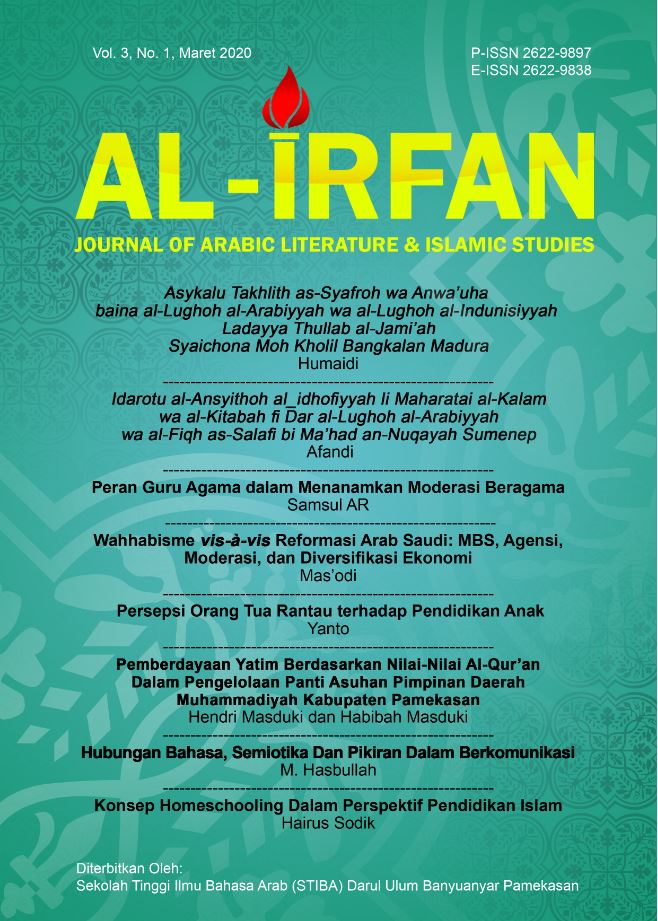
Peran Guru Agama Dalam Menanamkan Moderasi Beragama
DOI:
https://doi.org/10.58223/al-irfan.v3i1.712Keywords:
Moderation, Islamic, and Religious TeacherAbstract
Islam encourages the followers to be moderate, belances, not extreme, and not inclusive. TheTawasuthis part of the moderation of religion that must be embededto the students so that students have a moderate attitude in thier life of the nation and state. In the middle of the advancement of the Indonesian nation, religious moderation is needed by all human being and its must be taught to students so that they can become peaceful, compassionate and tolerance people in the future. The involvement of religious teachers in providing understanding of the tawasuth for the students are needed in order that its can be habatuation in their life. The content of Islamic religious education is emphasized on the understanding of compassion, mutual love, mutual respect, and help each other in kindness. Because with this understanding, the students can implement it in their daily life. This paper explains the role of religious teacher in embeding religious moderation. This paper uses the library research method with a descriptive analysis approach.
References
Baidhawy, Zakiyuddin. Pendidikan Agama Berwawasan Multikultural, Jakarta: Earlangga, 2005.
H.A.R. Tilaar. Multikulturalisme Tantangan Global Masa Depan dalam Transformasi Pendidikan Nasional, Jakarta: Grasindo, 2003.
Iyubenu, Edi Ah. Hate Speech’ dalam Kecamata Islam, Kedaulatan Rakyat, 13 November 2015, hlm. 12.
Majid, Nurkholis. Pluralitas Agama: Kerukunan dalam Kergaman, Jakarta: Kompas Nusantra, 2001.
Uno,Hamzah B. Profesi Kependidikan, Problema, Solusi, dan Reformasi Pendidikan di Indonesia,Jakarta: Bumi Aksara, 2007.
Kementerian Agama, R. I. "Moderasi Beragama." Jakarta: Badan Litbang dan Diklat Kemenag RI, 2019.
Fatoni,Muhammad Sulton. Buku Pintar Islam Nusantra, Tanggeran Selatan: IIMaN, 2017.
Ramayulis. Metodologi Pengajaran Islam, Jakarta: Kalam Mulia, 1994.
Alpandie, Imansjah. Didaktik Metodik, Surabaya: Usaha Nasiona, 1984.
Darajat, Zakiah. Metodologi Pengajaran Agama Islam, Jakarta: Bumi Aksara, 2008.
Eliason, Claudia, dkk., “A Pratical Guide To Early Childhood Curriculum, Eighth Edition” Columbus, Ohio: Pearson Merrill Prentice Hall, 2008.
Yakin,Ainul, Pendidikan Multikultural; Cross-Culture Understanding untuk Demokrasi dan Keadilan, Yogyakarta: Pilar Media, 2005.
Zamroni, Pendidikan Demokrasi pada Masyarakat Multikultural, Yogyakarta: Gavin Kalam Utama, 2011
Biyanto, Urgensi Plurarisme, Kedaulatan Rakyat, 13 November 2015, hlm. 12.
UU Republik Indonesia Nomor 20 Tahun 2003 tentang Sistem Pendidikan Nasiona, Jakarta: Lembaran Negara, 2003.
Tribujogja, Senin, 16 November 2015, hlm, 1
Undang-undang Pemerintah nomor 2 tahun 1989.
Jurnal
Al Arifin, Akhmad Hidayatullah, Implementasi Pendidikan Multikultural Dalam Praksis Pendidikan di Indonesia, Jurnal Pembangunan Pendidikan: Fondasi dan Aplikasi, UNY, Volume.1 Nomor 1 juni tahun 2012.
Ariyanto, Bambang "Peningkatan Perilaku Islami Anak Usia Dini Melalui Metode karyawisata." Jurnal Pendidikan Usia Dini 8.2 (2014).
Fauzi, Ahmad. "Moderasi Islam, Untuk Peradaban Dan Kemanusiaan." Jurnal Islam Nusantara 2.2 (2018)
Akhmadi, Agus. "Moderasi Beragama Dalam Keragaman Indonesia." Inovasi 13.2 (2019)
Internet
https://id.wikipedia.org/wiki/Diskusi,
https://jagad.id/pengertian-diskusi-macam-jenis-fungsi-manfaat-dan-tujuan/
Tarmidzi Tohor, https://bimasislam.kemenag.go.id/post/opini/pentingnya-moderasi-beragama
https://tafsirweb.com/598-surat-al-baqarah-ayat-143.html.
Kamus besar bahasa Indonesia online.
Downloads
Published
How to Cite
Issue
Section
License
Copyright (c) 2020 Samsul AR

This work is licensed under a Creative Commons Attribution 4.0 International License.
Lisensi :
Al-Irfan: Journal of Arabic Literature and Islamic Studies is published under conditions Creative Commons Attribution 4.0 International License / CC BY 4.0 This license permits anyone to copy and redistribute this material in any form or format, modify, modify, and make derivative works of this material for any purpose, including commercial purposes, so long as they credit the author for the original work.