
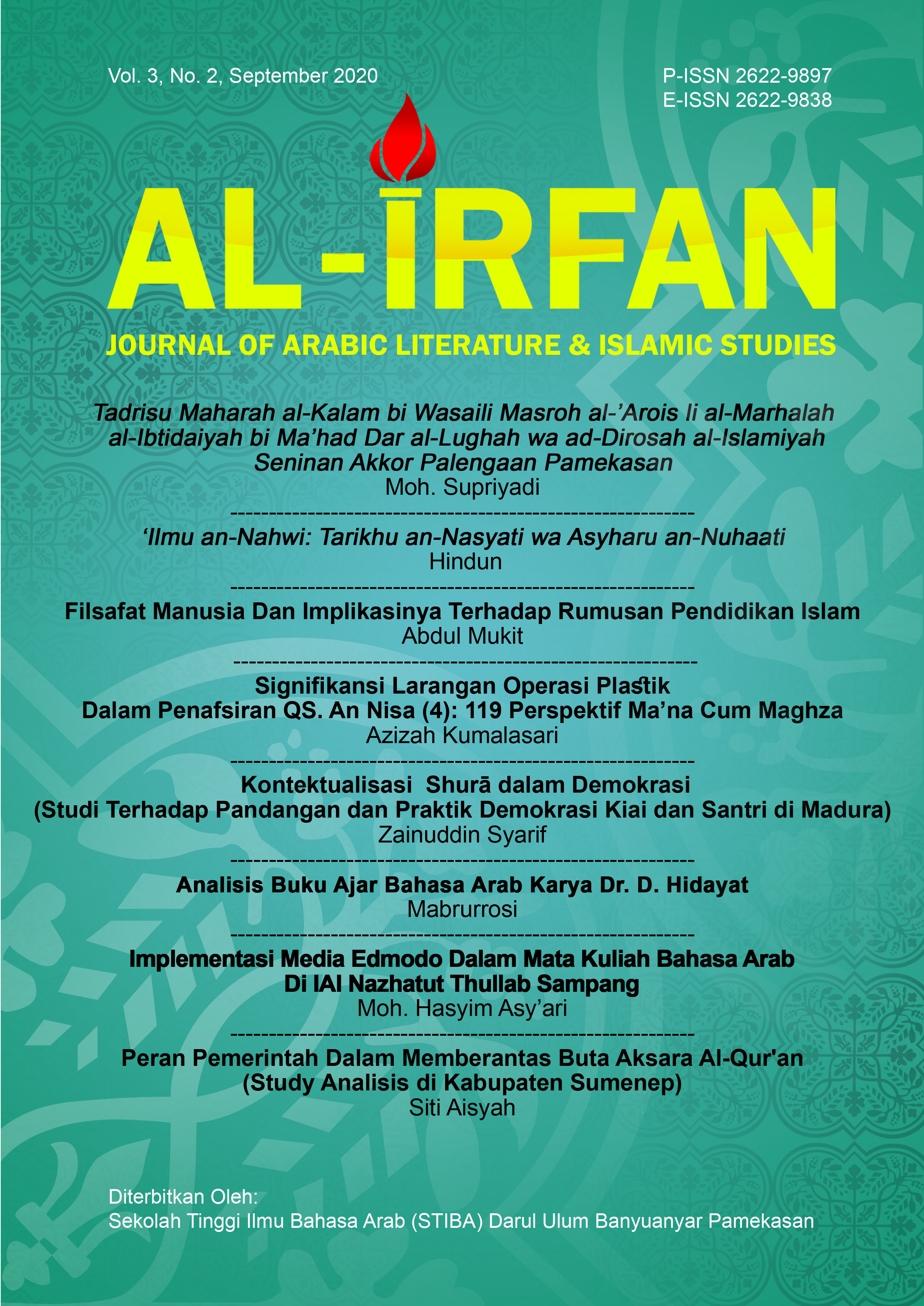
Arabic Grammar: The History of Its Emergence and the Most Prominent Grammarians
DOI:
https://doi.org/10.58223/al-irfan.v3i2.720Keywords:
Syntax, history, emergenceAbstract
The science of grammar is one of the highest sciences and the most beneficial. It has a strong relationship and connection to learning Arabic language skills. To make it easier to learn and understand grammar without much difficulty is to know and learn its history. When a student has studied its history, it becomes easier for him to learn hard and many rules are hidden for him. From this point of view, the researcher tried to clarify the history of grammar and what transforms what grammar is, the reason for its inception, its setting, and a simple explanation of the emergence of grammar and the history of the most famous grammarians.
The approach followed is the descriptive and analytical approach and the most important results of the research are: First, the reason for the emergence of grammar is the spread of melody and errors in pronunciation in general and the pronunciation of the Qur’an in particular, secondly the emergence of grammar is four phases, thirdly the two famous doctrines are Kufa and Basra
References
ابن جني، الخصائص، (بيروت لبنان: دار الكتاب العربي، 2010م).
السيد أحمد الهاشيمي، القواعد الاساسية للغة العربية، ( صيدا لبنان: دار الكتب العلمية، 2009م).
سعيد الأفغاني، من تاريخ النحو، ( بيروت: دار الفكر، 1978 م )
عبد الكريم محمد الاسعد، الوسيط في تاريخ النحو، (الرياض: دار الشواف 1992م).
علي محمد فاخر، تاريخ النحو العربي منذ نشأته حتى الان، (القاهرة: جامعة الازهر، 2003م)
محمد الطنطاوي، نشأة النحو و تاريخ أشهر النحاة، ( القاهرة: دار المعارف، 2005م)
مصطفى الغلاييني، جامع الدروس العربية، (لبنان : المكتبة العصرية، 2012م).
Downloads
Published
How to Cite
Issue
Section
License
Copyright (c) 2020 hindun hindun

This work is licensed under a Creative Commons Attribution 4.0 International License.
Lisensi :
Al-Irfan: Journal of Arabic Literature and Islamic Studies is published under conditions Creative Commons Attribution 4.0 International License / CC BY 4.0 This license permits anyone to copy and redistribute this material in any form or format, modify, modify, and make derivative works of this material for any purpose, including commercial purposes, so long as they credit the author for the original work.