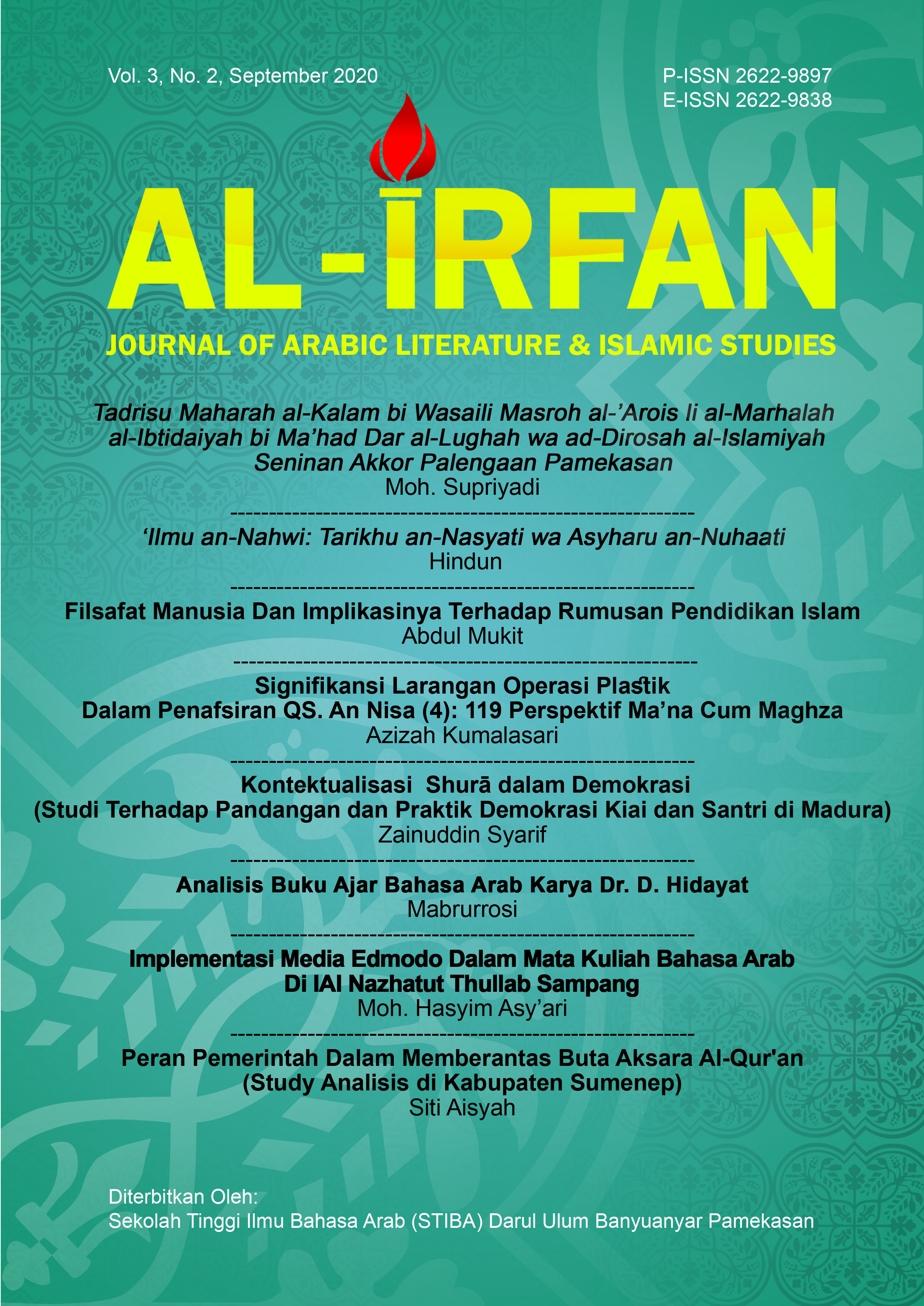
Signifikansi Larangan Operasi Plastik Dalam Penafsiran QS. An Nisa (4): 119 Perspektif Makna Cum Maghza
DOI:
https://doi.org/10.58223/al-irfan.v3i2.722Abstract
This article tries to find out the significance of the plastic surgery ban in Qs. An Nisa (4): 119. As this proposition is used to legitimize the practice of plastic surgery in the Qur’an prespective, on the other hand, its axinstence is increasingly becoming a trend among the public, which is known as cosmetic surgery. So that there is no commond ground between the morals in the Qur’an with all the interpretations and the phenomenon of cosmetic surgery. The author uses a thematic-analysis method with the theory of hermeneutic Makna cum maghza with an emphasis on the discussion of the sentence being examined for its meaning and a review of the macro and micro of its asbabun nuzul when the verse is reveealed. So that from reading both of them can take the significance or the main massage from Qs. An Nisa (4): 119. The results of the discussion this verse puts forard the benefit of the whole people, with several limitation that need to be considered when doing plastic surgery. Such as; as needed, does not change the function of the operated organs and does not harm others in the practice of organ transplantation.
References
Adawiyah, Rabiatul dkk, Pemutihan Kulit Dalam Prinsip Mengubah Ciptaan Allah SWT, Fikiran Masyarakat, Vol. 6, No. 2, 2018.
Al Bagawiy, Abu Muhammad al-Husain bin Mas’ud, Ma’alim At Tanzil, jilid 2, Cet.IV, (t.tp: Dar Thibah li an-Nasyr wa at-Tawzi’), 1997.
Al-Bagdadi, Abu al-Fadl Syihāb al-Din al-Sayyid Mahmud Afandi al-Alusi, Ruh al Ma’ani fi Tafsir al Qur’ an al ‘Aẓim wa al Sab’u al Matsani, Jilid 4 (Beirut: Dar al-Kutub al-ilmiyah, 2001).
Al Hafizh Abu Abdullah Muhammad bin Ismail al-Bukhari, Al Imam, Shahih Bukhari, (Jakarta: Pustaka As-Sunnah), 2010.
Ari, Shosh Ben, The Changing Attitude of Islam Toward Cosmetic Procedures And Plastic Surgery, Acta Orientalia Academiae Scientiarum Hungaricae, Vol. 66, No. 2, 2013.
Asy-Syafi'i, Syihabuddin Ahmad bin Husain bin Hasan bin Ali bin Yusuf bin Ali bin Arsilan ar-Ramli, Syarh Sunan Abu Dawud Li Ibnu Roslan, Jilid 16, (Damaskus: Darul Falah), 2016.
At-Thabari, Abu Ja’far bin Muhammad, Tafsir at-Thabari, (Jakarta: Pustaka Azzam, 2009), jilid 7.
Dean, Nicola R. dkk, “Defining Cosmetic Surgery”, Australian Journal Of Plastic Surgery, Vol. 1. No. 1. 2018.
Ibnu Manzur, Lisan al-Arab, Jilid 15, (Beirut: Darul Kutub Al-Ilmiyah) 2009.
Li, Jun dkk, “Predictive Factors For Cosmetic Surgery: A Hospital-Based Investigation” diakses pada 19 nopember 2019 pada Springer Plus.
Maghfiroh, Nurul dkk, Kajian Yuridis Operasi Plastik Sebagai Ijtihad Dalam Hukum Islam, The 2nd Univercity Research Coloquium 2015.
Rohmah, Lailatu, Kontekstualisasi Hadis Tentang Transplantasi, Jurnal Hikmah, Vol. XIV, No. 2, 2018.
Shihab, M. Quraish, Tafsir Al-Misbah Pesan, Kesan Dan Keserasian al-Qur’an, jilid 2, (Jakarta: Lentera Hati) 2016.
Syamsuddin, Sahiron, Hermeneutika Dan Pengembangan Ulumul Qur’an, (Yogyakarta: Naasea Press), 2017.
Wallace, A. B., “The History And Evolution Of Plastic Surgery”, Res Medica Journal of The Royal Medical Society, Vol. 4, No. 4, 1965.
Downloads
Published
How to Cite
Issue
Section
License
Copyright (c) 2020 Azizah Kumalasari

This work is licensed under a Creative Commons Attribution 4.0 International License.
Lisensi :
Al-Irfan: Journal of Arabic Literature and Islamic Studies is published under conditions Creative Commons Attribution 4.0 International License / CC BY 4.0 This license permits anyone to copy and redistribute this material in any form or format, modify, modify, and make derivative works of this material for any purpose, including commercial purposes, so long as they credit the author for the original work.