
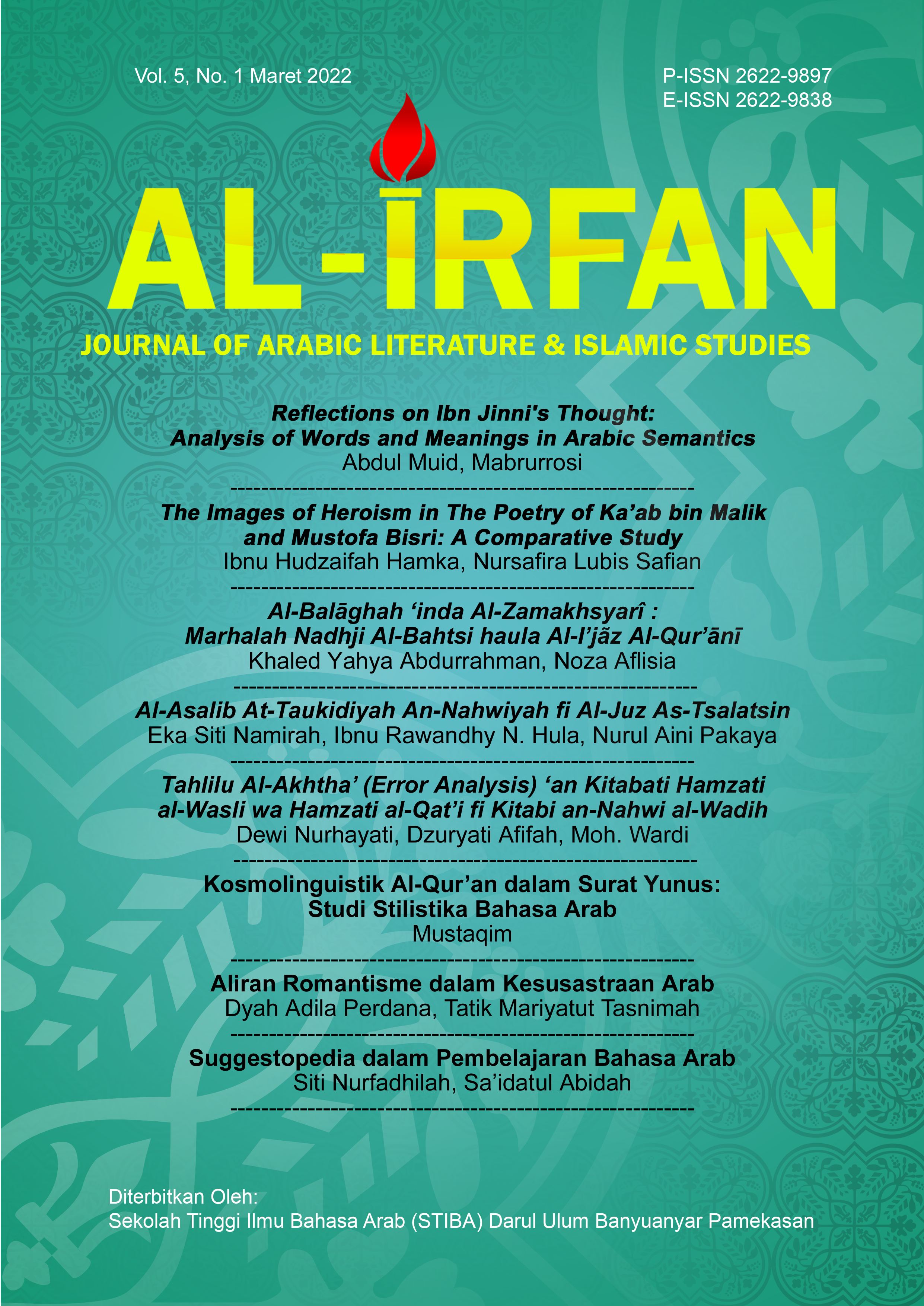
Al-Balāghah in the Thought of Al-Zamakhsharī: A Stage in the Maturation of Research on Qur’anic Inimitability (Iʿjāz al-Qurʾān)
DOI:
https://doi.org/10.58223/al-irfan.v5i1.748Keywords:
Rhetoric, Zamakhshari, Miracles, Qur'anAbstract
Zamakhshari's effort is limited to the practical aspect, and highlights the role of the science of eloquence in preparing the interpreter of the Book of God, and whether Zamakhshari added new to the rhetorical standards, and models of his interpretation showing his use of rhetorical rules in understanding the Book of God. This research is a desk research. The data obtained is processed by content analysis techniques. As for the results of the research, Zamakhshari is the pillar sought by the science of interpretation; Because it is his goal and purpose, just as the science of rhetoric that Zamakhshari employed in revealing the miracle of the Qur’an is closely related to the science of semantics. Zamakhshari tries to interpret the Qur’an by organizing the vocabulary of the material into a meaning that brings it together in a single structure within a single context. He draws attention to the effect of speech systems on the meaning, so he looks at the Qur’an with the look of the verified examiner, and accordingly, the meaning is interpreted and interpreted. It provokes a dialogue in one aspect, paving the way for another dialogue to move to another verse, and he thus follows the approach of Al-Jurjani in using dialogue to reach the desired goal. He cites poetry in his explanations, and poetry was an important aspect for him to infer the validity of his interpretations.
References
ابراهيم، معتز. (٢٠١٩). البلاغة في تفسير الزمخشري، الموسوعة العربية الشاملة، (mosoah.com)
بركة، عبدالغني محمد سعد. (١٩٨٩). الإعجاز القرآني وجوهه وأسراره، القاهرة : مكتبة وهبة.
توفيق، زاهره. (٢٠٠٢). الأوجه البلاغية والدلالية في تفسير الكشاف للزمخشري ، رسالة ماجستير.
فارس، خير الدين بن محمود بن محمد بن علي بن. (٢٠٠٢). الزركلي، الأعلام الناشر : دار العلم للملايين الطبعة، الخامسة عشر.
موسى، محمد حسين أبو. (د.س). البلاغة القرآنية في تفسير الزمخشري وأثرها في الدراسات البلاغية، القاهرة : دار الفكر العربي.
Aflisia, N. (2017). Musykilah Tarjamah al-Lughah al-’Arabiyyah Ila al-Lughah al-Indonesiyyah. ARABIYATUNA : Jurnal Bahasa Arab. https://doi.org/10.29240/jba.v1i1.198
Aflisia, N., Rini, R., & Yul, W. (2021). Dirāsah ‘an Al-Ibdāl fī ‘Ilmi Al-Sharfi. Lughawiyyat: Jurnal Pendidikan Bahasa Dan Sastra Arab, 4(1), 24–39. https://doi.org/10.38073/LUGHAWIYYAT.V4I1.420
Alfiyah, A. (2018). Kajian Kitab Al-Kasyaf Karya Zamakhsyari. In Jurnal Ilmu Al Quran dan Tafsir (Vol. 1). Retrieved from http://ejournal.iai-tabah.ac.id/index.php/Alfurqon/article/view/206
Ali Maghfur UIN Sunan Ampel, A., & Yani, J. A. (2020). Al-Muḥassināt al-Lafẓiyyah wa al-Maʽnawiyyah fī Maqāmāt al-Zamakhsyarī: Dirāsah Balāgiyah. JILSA (Jurnal Ilmu Linguistik Dan Sastra Arab), 4(1), 48–70. https://doi.org/10.15642/JILSA.2020.4.1.48-70
Ridho, A. R. (2019). Analisis Kajian Morfologi Az-Zmakhsyari dalam Tafsir Al-Kasysyaf. El-’Umdah, 2(1), 16–37. https://doi.org/10.20414/el-umdah.v2i1.910
Supriadi. (2014). Karakteristik Penafsiran Zamakhsyari Terhadap Ayat-ayat Fasik. Jurnal Asy-Syukriyyah, 12(April), 72–97. https://doi.org/10.36769/ASY.V12I1.57
Wahyuni, R. (2019). Al-Ushul Al-Khamsah Perspektif Zamakhsyari Studi Kritis Penafsiran Ayat-Ayat Terkait Al-Ushul Al-Khamsah dalam Tafsir Al-Kasysyaf (Pascasarjana Institut Ilmu Al-Qur’an (IIQ) Jakarta). Retrieved from http://repository.iiq.ac.id//handle/123456789/200
Downloads
Published
How to Cite
Issue
Section
License
Copyright (c) 2022 adminojs adminojs; Khaled Yahya Abdurrahman, Noza Aflisia

This work is licensed under a Creative Commons Attribution 4.0 International License.
Lisensi :
Al-Irfan: Journal of Arabic Literature and Islamic Studies is published under conditions Creative Commons Attribution 4.0 International License / CC BY 4.0 This license permits anyone to copy and redistribute this material in any form or format, modify, modify, and make derivative works of this material for any purpose, including commercial purposes, so long as they credit the author for the original work.