
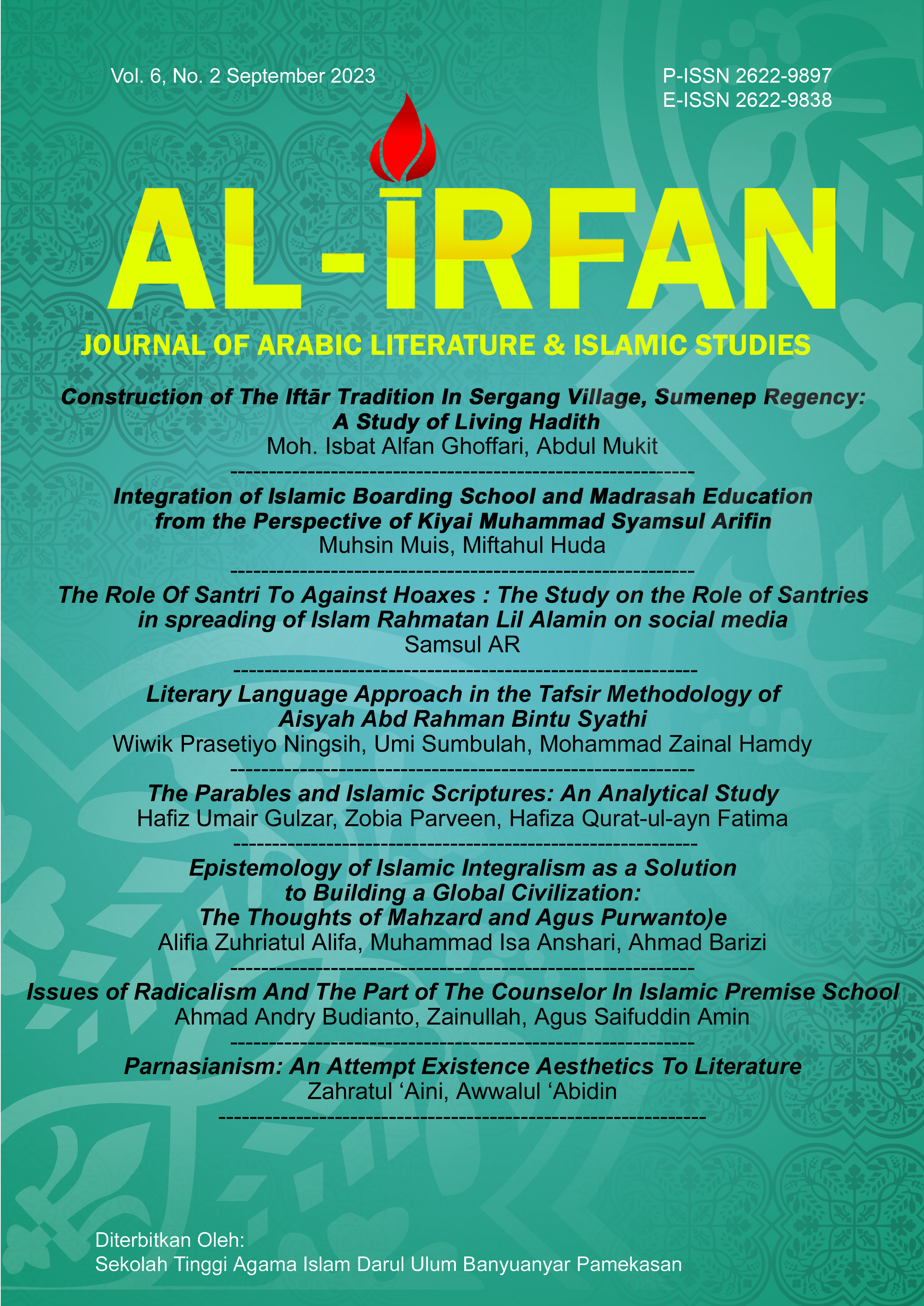
The Parables and Islamic Scriptures An Analytical Study
DOI:
https://doi.org/10.58223/al-irfan.v6i2.775Keywords:
Parables, Quran, Hadith, Sufi LiteratureAbstract
Allah the exalted is the only Lord of all the worlds. He has sent Prophets and Messengers in all periods to guide the mankind. He has also revealed Divine Scriptures to edify mankind. Several Manuscripts and Books were revealed on different Prophets. The Qur’ān is the last and final word of Allah towards the humanity till the Day of Judgment. The Qur’ān teaches humanity about the Unity of Allah, love and obedience of Prophet Muhammad PBUH, methods of worship and many more. In the Qur’ān, different unique methods have been adopted for the purpose of guidance e.g. literary method, psychological, interrogative, method of telling a story of past times, etc. Parabolic method is one of these methods. In this article the significance and details of the parabolic method will be analyzed. It is the convention of Allah to teach through this method. The Apostles of Allah have also adopted this method to preach the word of Allah in an easier way
References
Ibn al-Fāris, Aḥmad, Abū al-Ḥasan, Mu’jam Maqāyīs al-Lughah, Dār al-Fikr, Beirut, 1979, vol. 5,
Zamakhsharī, Maḥmūd b. ‘Amr b. Aḥmad, Asās al-Balāgha, Dār al-Kutub al-‘Ilmiyya, Beirut, Lebanon, 1998 vol. 2
Ibn Taymiyya, Aḥmad b. ‘Abd al-Ḥalīm, Majmū’ al-Fatāwā, Idārāt al-Baḥūth al-‘Ilmiyya, al-Riyaz, Saudia, 1978, vol. 14,
Jawziyya, Muhammad b. Abī Bakr Ayyūb Ibn Qayyim, al-Amthāl fi al-Qur’ān, Dār al-Ma’rifa, Beirut, 2000,
Bayhaqī, Aḥmad b. al-Ḥusayn, Shu‘ab al- Ῑmān, Book, Fi Qir’āt al- Qur’ān bi Tafkhīm wa al-I‘rāb, h. # 2293.
Ḥākim, Muhammad b. ‘Abd Allāh, al-Mustadrak ‘Ala Ṣaḥīḥyn, Book, Faḍā’l al-Qur’ān, Chapter, Akhbār fī al-Faḍā’l al-Qur’ān, h. # 2031.
al-Qatān, Manā b. Khalil, Mubahith fil ‘Ulūm al-Qur’ān,
Imam Hāfiz Abū ‘Ῑsā Muhammad Ibn ‘Ῑsā al-Tirmidhī, Jāmi‘ al-Tirmidhī, Translated by Abu Khalīl, Maktaba Dār-us-Salām, 2007, vol. 5,
Ḥanbal, Aḥmad, Musnad Aḥmad bin Ḥanbal, Maktaba Dār al-Fikar, 2007, VOL. 6 h. #.
Ibn Kathir, Abū al-Fidā’ Ismā‘īl b. ‘Umar. Tafsīr al-Qur’ān, Beruit: Dar al-Fikr, VOL. 4
Siyūṭī, Jalāl al-Dīn, ‘Abd al-Raḥmān, al-Itiqān fī ‘Ulūm al-Qur’ān, Dār al-Fikr, Lebanon, 1996, vol. 4
Morteza, Afshari, Study of Mental Imagery in the Parable of the Qur’ān with Emphasis on the Function, The Turkish Online Journal of Design, Art and Communication, NO: 10.7456/1060NVSE/086, (November 2016),
Tahir-ul-Qadri, Dr., Durūs Mtahnawī, Biography of Mawlānā Rūm Methodology of Mathanawī, Lahore Lecture # Fn-10, 7 June, 2018, Itikaf City.
Tahir-ul-Qadri, Dr., Qur’ānic Encyclopaedia, Minhaj-ul-Qur’ān Publications, Manchester, 2019, vol. 3,
Ibn al-Qayyim, Paragons of the Qur’ān,
Tirmidhī, Jāmi‘ al-Tirmidhī, Vol. 5, Book 42, Hadith 2874
Lose Colendrino & Manuel R. Guerrero, 1993, Introduction to Psychology, Rex printing company, pp.
Ibn ‘Arabī, Muḥy al-Dīn, al-Fatūḥāt al-Makkiya, Dār al-Kutub al-Ilmiyya, Lebanon-Beirut, 1970, vol. 1,
Downloads
Published
How to Cite
Issue
Section
License
Copyright (c) 2023 adminojs adminojs; Hafiz Umair Gulzar, Zobia Parveen, Hafiza Qurat-ul-ayn Fatima

This work is licensed under a Creative Commons Attribution 4.0 International License.
Lisensi :
Al-Irfan: Journal of Arabic Literature and Islamic Studies is published under conditions Creative Commons Attribution 4.0 International License / CC BY 4.0 This license permits anyone to copy and redistribute this material in any form or format, modify, modify, and make derivative works of this material for any purpose, including commercial purposes, so long as they credit the author for the original work.