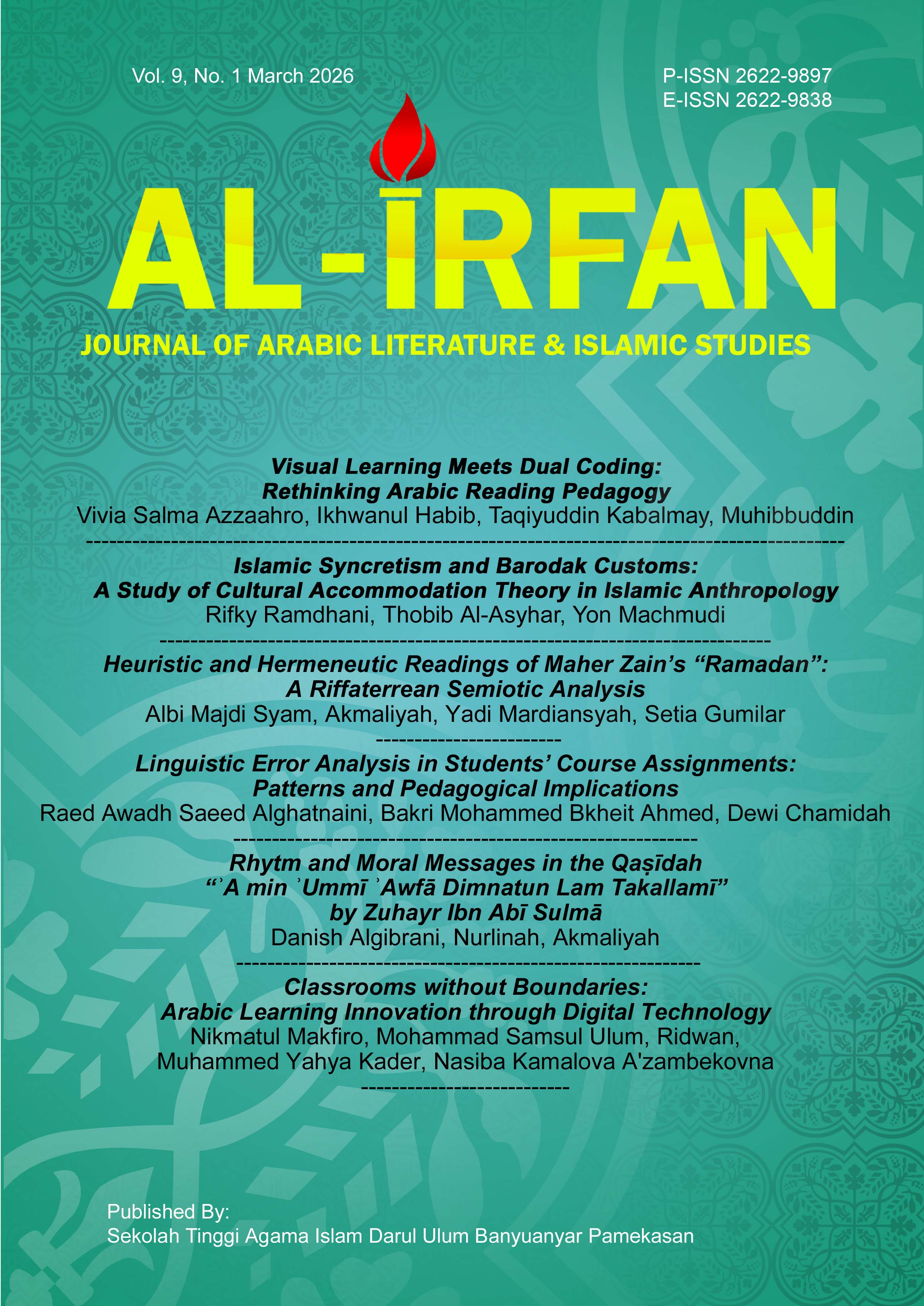
Classrooms without Boundaries: Arabic Learning Innovation through Digital Technology
DOI:
https://doi.org/10.58223/al-irfan.v9i1.561Keywords:
Digital Technology, Arabic Learning, Learning InnovationAbstract
Major changes in education in the digital age have encouraged non-formal institutions to innovate, including the KUBA program in Malang. Limited space, time, and resources have made digital technology a key strategy for expanding access and supporting contextual learning. This study analyzes the use of digital technology in Arabic language learning at KUBA Malang, focusing on teacher strategies, participant engagement, and challenges encountered. A qualitative case study was applied, with data collected through semi-structured interviews and documentation, then analyzed using the Miles, Huberman, and Saldaña model with triangulation of sources. The results show that KUBA integrates Google Meet for online classes, WhatsApp for coordination, and Quizizz for assessment. Innovations are seen in digital comics, animated videos, and native speaker audio, which facilitate vocabulary learning and improve speaking skills. The main challenge is unstable internet connection, which is overcome by providing class recordings for students who cannot attend or experience technical problems. KUBA also offers guidance in routine speaking activities to support material and mental readiness. This study concludes that creative digital media at KUBA Malang not only expands access but also offers an innovative approach that is relevant to non-formal education in the digital era.
References
A. Rani, S., Zikriati, Z., Muhammady, A., Syukran, S., & Ali, B. (2023). Arabic Language Learning Based on Technology (Opportunities and Challenges in the Digital Era). International Journal of Education, Language, and Social Science, 1(1), 1–11. https://doi.org/10.62612/ijelass.v1i1.4
Abdurahman, Arum Tri Budiarti, Khairun Nisa, & Sahkholid Nasution. (2025). Peluang dan Hambatan Digital dalam Pembelajaran Bahasa Arab : Prespektif Guru dan Mahasiswa. Karakter : Jurnal Riset Ilmu Pendidikan Islam, 2(2), 322–335. https://doi.org/10.61132/karakter.v2i2.625
Afril, R., Husna, I., & Jasem, H. (2024). Learning Arabic in the Digital Era : Challenges and Effective Strategies. Arabiyati, 1(1), 198–220. https://journal.pppbai.or.id/index.php/arabiyati/article/view/7%0Ahttps://journal.pppbai.or.id/index.php/arabiyati/article/download/7/11
Al Haddad, A., Hasaniyah, N., & Al Anshory, A. M. (2025). Pengaruh Media Visual Terhadap Peningkatan Kosakata Bahasa Arab: Telaah Teoritis. Jurnal Teknologi Pendidikan Dan Pembelajaran| E-ISSN: 3026-6629, 2(4), 1111–1117. https://jurnal.kopusindo.com/index.php/jtpp/article/view/967/897
Aldereza Lidiya Mazyuna, & Mad’ali Mad’ali. (2025). Reformulasi Strategi Pembelajaran Bahasa Arab di Era Disrupsi Digital: Perspektif Kontemporer Pendidikan di Indonesia. Khatulistiwa: Jurnal Pendidikan Dan Sosial Humaniora, 5(2), 32–46. https://doi.org/10.55606/khatulistiwa.v5i2.5756
Bozkurt, A., & Ataizi, M. (2020). English 2.0: Learning and Acquisition of English in the Networked Globe with Connectivist Approach. Contemporary Educational Technology, 6(2), 155–168. https://doi.org/10.30935/cedtech/6146
Fauzi, M. F., Fauzan, M., Imani, H. I. A.-S., Haq, K. A., & Anindiati, I. (2023). Pelatihan dan Pendampingan Implementasi Fundamental Digital Skills dalam Pengajaran Bahasa Arab bagi Guru IMLA dan Forum MGMP Bahasa Arab Jawa Timur 1. Jurnal Tifani, 3(3), 1–8. http://tifani.org/index.php/tifani/article/view/58
Fiantika, Wasil M, Jumiyati, Honesti, Wahyuni, J. (2022). Metodologi Penelitian Kualitatif. In Metodologi Penelitian Kualitatif. In Y. Novita (Ed.), Rake Sarasin (1st ed., Issue Maret). PT. Global Eksekutif teknologi. https://scholar.google.com/citations?user=O-B3eJYAAAAJ&hl=en
Haniefa, R., & Samsudin, M. (2025). EFEKTIVITAS COMPUTER ASSISTED LANGUAGE LEARNING BERBASIS WEB DALAM MENIGKATKAN KETERAMPILAN BERBICARA BAHASA Abstrak. Ta’limi: Journal of Arabic Education & Arabic Studies, 4(1), 59–72. https://doi.org/https://doi.org/10.53038/tlmi.v4i1.195
Haq, S. (2023). Pembelajaran Bahasa Arab di Era Digital: Problematika dan Solusi dalam Pengembangan Media. MUKADIMAH: Jurnal Pendidikan, Sejarah, Dan Ilmu-Ilmu Sosial, 7(1), 211–222.
Hashimov, E. (2015). Qualitative Data Analysis: A Methods Sourcebook and The Coding Manual for Qualitative Researchers. Technical Communication Quarterly, 24(1), 109–112. https://doi.org/10.1080/10572252.2015.975966
Izzah, M. A., & Ma’sum, A. (2021). Pengembangan Komik Digital sebagai Media Pembelajaran Bahasa Arab Maharah Qira’ah untuk Siswa Kelas X MA Almaarif Singosari. JoLLA: Journal of Language, Literature, and Arts, 1(8), 1081–1094. https://doi.org/10.17977/um064v1i82021p1081-1094
Kanellopoulou, C., Kermanidis, K. L., & Giannakoulopoulos, A. (2019). The dual-coding and multimedia learning theories: Film subtitles as a vocabulary teaching tool. Education Sciences, 9(3). https://doi.org/10.3390/educsci9030210
Maghfurin, ِa., Maisaroh, I., Himawan Akbar, M. A., Ramadhan, M. R., & Bahaudin, M. I. (2023). Implementation of Behavioral and Cognitive Theories in the Arabic Language Learning Curriculum: a Conceptual Review. Al Mi’yar: Jurnal Ilmiah Pembelajaran Bahasa Arab Dan Kebahasaaraban, 6(2), 325. https://doi.org/10.35931/am.v6i2.2609
Makfiro, N., Fithriyah, A., Nidhomillah, A. rofi fathoni, & Mustofa, S. (2024). Eksplorasi Motivasi Belajar Bahasa Arab Menggunakan Video pada Mahasiswa Magister Pendidikan Bahasa Arab. Borneo Journal of Language and Education, 4(2), 264–277. https://doi.org/10.32505/Hikmah.V14i1.6133.5
Makfiro, N., Thoyyibah, A., & Mauludiyah, L. (2022). Improvement of Learning Arabic Interest by Using Animation Video in Students’ Junior High School. Lisanan Arabiya: Jurnal Pendidikan Bahasa Arab, 6(1), 19–44. https://doi.org/10.32699/liar.v6i1.2398
Mayer, B. S. (2025). Digital informal learning through connectivism and networked learning: the case of arabic culture groups. Discover Education, 4(1), 1–13. https://doi.org/10.1007/s44217-025-00526-2
Mishra, P., & Koehler, M. J. (2006). Technological Pedagogical Content Knowledge: A Framework for Teacher Knowledge. Teachers College Record: The Voice of Scholarship in Education, 108(6), 1017–1054. https://doi.org/10.1111/j.1467-9620.2006.00684.x
Muhammad Sidiq, H. (2022). Pembelajaran Bahasa Arab Secara Daring Di Masa Pandemi Covid-19. SIBATIK JOURNAL: Jurnal Ilmiah Bidang Sosial, Ekonomi, Budaya, Teknologi, Dan Pendidikan, 1(10), 2013–2030. https://doi.org/10.54443/sibatik.v1i10.297
Muzakki, A. A., Harisca, R., & Abdilah, H. I. (2025). Transformasi Pembelajaran Bahasa Arab Di Era Digital: Antara Inovasi Teknologi Dan Tantangan Penerapan. Qolamuna: Keislaman, Pendidikan, Literasi, Dan Humaniora, 2(1), 37–48. http://jurnal.qolamuna.id/index.php/JQ
Nabila Ramadhani. (2021). Pengajaran Bahasa Arab Berbasis Distance Learning (Studi Kasus di Program Tamyiz Online) [Universitas Negeri Jakarta]. http://repository.unj.ac.id/19309/
Nur, S., & Sahrul Ramadan. (2025). Tantangan Implementasi Dan Peluang Pada Pembelajaran Bahasa Arab Di Era Digital. An-Nashr: Jurnal Ilmiah Pendidikan Dan Sosial Kemasyarakatan, 3(1). https://jurnal.asy-syifa.id/index.php/an-nashr/article/view/75/28
Nuraman. (2020). EFEKTIVITAS PENGAPLIKASIAN TEKNOLOGI E-LEARNING DALAM PEMBELAJARAN BAHASA ARAB (Studi Kasus di Kelas Bahasa MAN 2 Kota Serang, Banten) TESIS [Universitas Islam Negeri Syarif Hidayatullah Jakarta]. In Repository.Uinjkt.Ac.Id. https://repository.uinjkt.ac.id/dspace/bitstream/123456789/57492/1/NURAMAN - SPs.pdf
Olawale, B. E., Omodan, B. I., & Saddiq, K. (2025). X-raying the enablers and barriers of e-learning in higher education institutions : a systematic review. Frontiers in Education, 10(1), 1–18. https://doi.org/10.3389/feduc.2025.1526076
Rahmawati, A. E., Zulhannan, Hijriyyah, U., Erlina, & Koderi. (2023). Development of the Quizizz Application-Based Evaluation Tool for Learning Arabic for MTs│Pengembangan Alat Evaluasi Berbasis Aplikasi Quizizz pada Pembelajaran Bahasa Arab untuk MTs. Mantiqu Tayr: Journal of Arabic Language, 3(2), 135–150. https://doi.org/10.25217/mantiqutayr.v3i2.3484
Ridwan, & Novalita Frannsisca Tungka. (2024). Metodologi Penelitian (L. O. A. Dani (ed.)). Yayasan Sahabat Alam Rafflesia. http://eprints2.ipdn.ac.id/id/eprint/1362/1/Metedologi Penelitian %28DONE%29.pdf
Ritonga, S., Fuadi, K., & Ritonga, M. (2024). Technology and Social Media Integration in Arabic Language Education : Critical Implementation Analysis and Policy Frameworks for Indonesia. Lughawiyah, 7(1), 52–65. https://doi.org/http://dx.doi.org/10.31958/lughawiyah.v7i1.15158
Safitri, A., Alfattunisa, A., Afifah, A., Abdullah, D., & Mardani, D. (2025). Efektivitas Media Interaktif Berbasis Digital dalam Pembelajaran Bahasa Arab Untuk Siswa MI. Wulang: Jurnal Pendidikan Guru Madrasah Ibtidaiyah, 3(2), 45–56. https://doi.org/10.55656/wjp.v3i2.355
Safitriani, I., Khasairi, M., Alfan, M., Budi, A., Ayni, N., & Ahgaff, U. Al. (2025). Exploring Arabic Reading and Speaking Skills through Picture Storybooks : Study Literature Review. Mantiqu Tayr: Journal of Arabic Language, 5(2), 1–22. https://doi.org/https://doi.org/10.25217/mantiqutayr.v5i2.6111
Sugiono. (2017). Metode Penelitian Pendidikan Pendekatan Kuantitatif, Kualitattif dan R&D (25th ed.). ALFABETA. https://www.scribd.com/document/688009736/Metode-Penelitian-Kuantitatif-Kualitatif-Dan-R-D-Prof-Dr-Sugiyono-2017
Sukanto, D. (2020). Pembelajaran Jarak Jauh dengan Media e-Learning Sebagai Solusi Pembelajaran Pada Masa Pandemi Corona Virus Disease 2019 (COVID 19). Syntax Idea, 21(1), 1–9. https://www.mdpi.com/2227-7102/9/3/210
Sutinalvi, V., Harahap, A., Lubis, M. yusri ali, & Nasution, S. (2025). Pembelajaran Bahasa Arab di Era Digital: Tantangan Implementasi, dan Peluang. Mutiara: Jurnal Penelitian Dan Karya Ilmiah, 3(1), 987–998. https://doi.org/https://doi.org/10.59059/mutiara.v3i1.1969
Wibowo, S., Wangid, M. N., & Firdaus, F. M. (2025). The relevance of Vygotsky’s constructivism learning theory with the differentiated learning primary schools. Journal of Education and Learning (EduLearn), 19(1), 431–440. https://doi.org/10.11591/edulearn.v19i1.21197
Yiting Han. (2020). Connecting the Past to the Future of Computer-assisted Language Learning: Theory, Practice, and Research. Issue and Trends in Learning Technologies, 8(1), 1–9. https://doi.org/https://doi.org/10.2458/azu_itlt_v8i1_han
Zuchri Abdussamad. (2021). Metode Penelitian Kualitatif (Patta Rapanna (ed.); 1st ed.). CV. Syakir Meida Press. https://www.google.co.id/books/edition/Metode_Penelitian_Kualitatif/JtKREAAAQBAJ?hl=id&gbpv=1
Downloads
Published
How to Cite
Issue
Section
License
Copyright (c) 2026 Nikmatul Makfiro, Mohammad Samsul Ulum, Ridwan, Muhammed Yahya Kader, Nasiba Kamalova A'zambekovna

This work is licensed under a Creative Commons Attribution 4.0 International License.
Lisensi :
Al-Irfan: Journal of Arabic Literature and Islamic Studies is published under conditions Creative Commons Attribution 4.0 International License / CC BY 4.0 This license permits anyone to copy and redistribute this material in any form or format, modify, modify, and make derivative works of this material for any purpose, including commercial purposes, so long as they credit the author for the original work.